The Rare-Earth Chokehold
America squeezed China's chips; China squeezed the world's rare earths. Case-by-case licensing now reaches Taiwan's jugular.
Article contents01 / 07
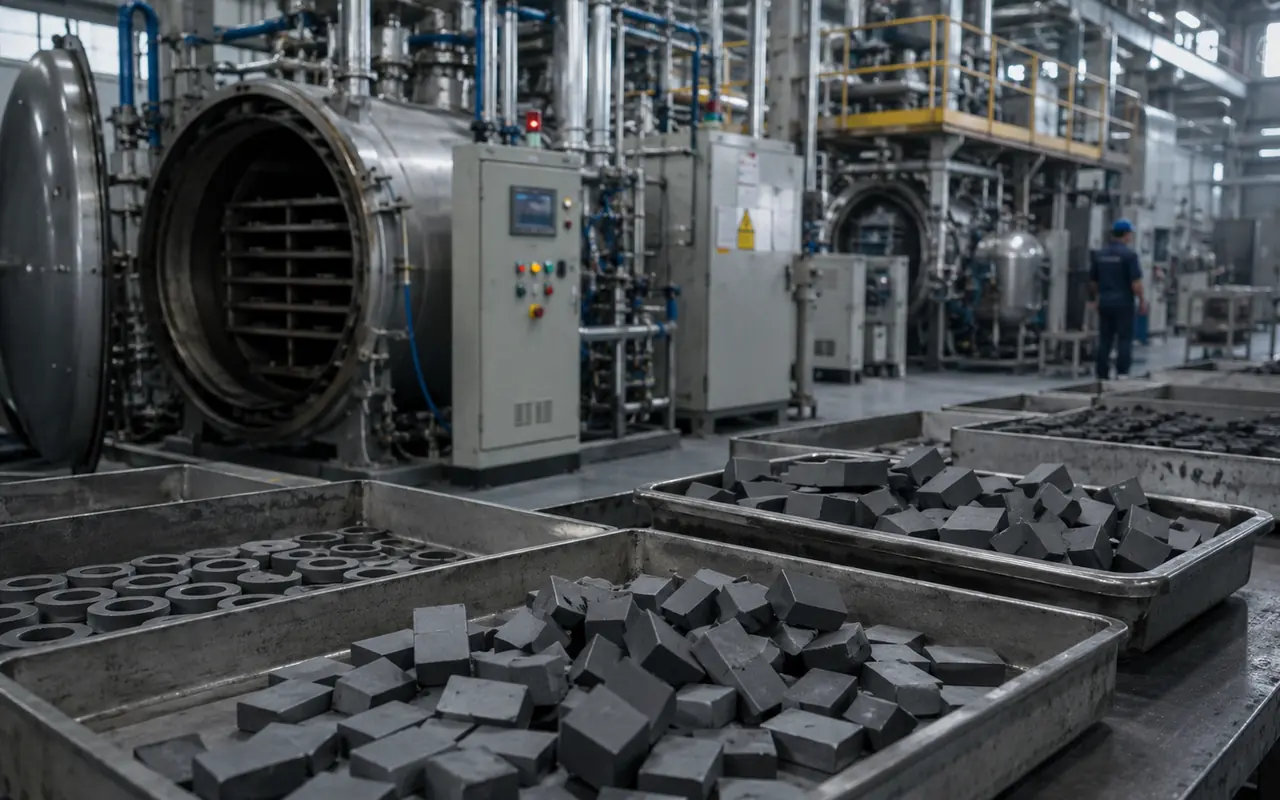
- In April 2025, China required national-security approval for exports of seven heavy rare earths (Sm, Gd, Tb, Dy, Lu, Sc, Y); in October it escalated to case-by-case review for rare earths destined for sub-14nm logic chips and 256-layer-plus memory.
- China's leverage rests on refining dominance: the IEA finds China is the top refiner for 19 of 20 critical strategic minerals, averaging ~70% market share. The bottleneck is refining and separation — a gap the West cannot close quickly.
- The chokehold need not grip Taiwan directly; throttling upstream partners such as Japan transmits the pressure just the same. Taiwan's greater concern is not immediate supply cut-off but rising costs, longer lead times, and sustained uncertainty.
In April 2025, China's Ministry of Commerce published a list of seven names most people cannot pronounce: Samarium, Gadolinium, Terbium, Dysprosium, Lutetium, Scandium, Yttrium. Heavy rare earths, now requiring national-security approval for export [6]. For most people, a dull trade notice; for global manufacturing, the sound of a chokehold quietly tightening.
The effect was immediate. April and May saw export volumes plunge; European and American automakers suddenly found they could not source permanent-magnet motors — some throttled output, some temporarily shut down [3]. A list almost nobody could read brought production lines on the other side of the world to a standstill. This report, from Taiwan's vantage point, dissects how this chokehold works, why it is so effective, and where it ultimately grips Taiwan's own supply chain.
A List of Seven Elements
These seven elements, though unfamiliar by name, are the vitamins of modern industry — small quantities, indispensable. Dysprosium and Terbium keep permanent magnets performing at high temperatures; they are critical for EVs, wind turbines, precision motors, and defense equipment. Yttrium and Scandium appear in specialty alloys, lasers, and displays. They are threaded through nearly every supply chain from smartphones to missiles.
China's list is frightening not because it bans exports, but because it requires approval. The licensing regime gives Beijing a valve it can tighten or loosen at will: no blanket embargo on the surface, but every single shipment needs a nod from the ministry [6]. This design — "we don't close the door, we just hold the key" — is more flexible than an outright ban and far harder to counter. It keeps adversaries in a permanent state of uncertainty.
The most effective weapon is often not an embargo but the approval — not closing the door, but keeping the key firmly in your own hand.
The Escalation: Targeting 14 Nanometers
If April's controls were a test of the water, October's escalation bared the fangs. In October 2025, China extended controls to the production technology itself — mining, smelting, and separation know-how were brought into scope; more critically, rare earths destined for advanced semiconductors were subjected to case-by-case review [3].
The thresholds it named are precise enough to send a chill down the spine: logic chips at 14nm and below, memory at 256 layers and above [6]. That is exactly the range of today's most advanced nodes — and exactly Taiwan's core battlefield. Beijing was telling the world plainly: the most cutting-edge chips, I have a way to reach them from the upstream, raw-material end.
Technology experts counsel against panic: rare earths are not the primary input of chips; they feature more in process equipment, specialty materials, and magnetic components. The effect of a supply disruption would be to "slow down" rather than "immediately paralyze" (assessed, medium confidence). But in an industry where yield rates and delivery schedules decide everything, slowing down is itself a form of damage.
Pause, Not Retreat
Just as the world braced for a showdown, the plot reversed. On November 7, 2025, China announced that the October escalation would be deferred until November 10, 2026 [4]. Markets exhaled — but reading this move correctly reveals Beijing's hand.
What was "deferred" was only the October upgrade; the original April controls remain fully in effect, and every relevant shipment still requires Ministry of Commerce clearance [6]. In other words, the chokehold has not loosened — it has simply paused at "half-tightened." This is the standard use of a negotiating card: display the firepower, generate the fear, then pull back slightly and convert the "pause" into a chip that can be revoked at any time.
Why This Is a Trump Card: 70% Dominance
China's confidence to play this hand rests on a stunning figure. The International Energy Agency (IEA) reports that of 20 critical strategic minerals, China is the top refiner for 19, with an average market share of around 70% [2]. The key is not "mining" — rare earths are actually not particularly scarce in the earth's crust. The true bottleneck is the refining and separation process: dirty, technically demanding, and perfected over decades by China.
This is why, even if the West starts building its own supply chains today, the near-term gap cannot be filled. S&P Global estimates rare-earth supply bottlenecks will persist through 2026 [1]. China's controls have accelerated de-risking and diversification efforts in the U.S., Australia, and Japan [7] — but "accelerating" and "filling the gap" are separated by several years. During that window, this card is real.
Two Mirrors: America and China Choking Each Other
Step back and you see a picture that is almost poetic in its symmetry. As this publication discussed in "The Frontier Is Not the Finish," the United States is using export controls to squeeze China's high-end chips, keeping Huawei's Ascend stuck at 7nm. And now China is using its ~70%-refined rare earths to squeeze the rest of the world.
America grips the "downstream brain"; China grips the "upstream blood." One stops you from computing; the other stops you from manufacturing. This is a mutual chokehold with no winner: each superpower holds a chokepoint in the other's supply chain, and neither dares fully squeeze, because squeezing the other to death also strangles itself and the entire world. The eventual "pause" on rare-earth controls is, in some measure, the product of this mutual deterrence.
America squeezes chips; China squeezes rare earths. One stops you computing; the other stops you manufacturing — a mutual chokehold neither dares to close all the way.
Where the Chokehold Grips Taiwan
So where does this contest of giants grip Taiwan? The answer: Taiwan stands precisely at the point where the chokehold tightens.
As the core of the world's most advanced chip and electronics supply chains, Taiwan's manufacturing is deeply dependent on stable access to key materials — from process equipment and specialty materials to permanent-magnet components [5]. China's "case-by-case review for sub-14nm" design places the approval uncertainty directly above Taiwan's most advanced — and most profitable — production lines. Taiwan's greater concern is not "immediate supply cut-off" but rising costs, longer lead times, and sustained uncertainty.
The indirect effects deserve equal vigilance. In early 2026, China imposed strict controls on dual-use items shipped to Japan [6]; Japan is one of the few countries outside China capable of producing rare-earth permanent magnets. If Japan's raw material access is impeded, the entire downstream — including the Japanese-sourced materials and equipment on which Taiwan depends — will feel the tremors. The chokehold does not have to grip Taiwan's throat directly; throttling Taiwan's upstream partners transmits the effect just the same.
Three Stances: Breathing Under the Chokehold
From Taiwan's vantage point, this chokehold cannot be cut with one stroke, but Taiwan can learn to breathe steadily beneath it. Our team has converged on three positional stances (decision-oriented; not investment advice).
For the state, the task is to elevate "critical material security" to the same strategic priority as chips: audit Taiwan's true exposure to controlled minerals, build strategic reserves, and co-build "de-China" alternative supply chains with allies in the U.S., Japan, and Australia. All of this takes time, which is precisely why action is needed sooner rather than later — the "pause" card expires in November 2026.
For industry associations, the task is to map exposure down to the cluster level: help members audit which materials and processes sit on the controlled list, and build collective purchasing mechanisms for alternative sources and safety stockpiles — distributing a risk that no individual company can bear alone.
For SMEs, the most pragmatic directive is this: first find out whether those seven unpronounceable elements are anywhere in your supply chain. Most small businesses do not even know that a component they buy contains a controlled rare earth. Auditing your upstream bill of materials and having alternative sourcing ready is the first step to protecting yourself in this contest of giants. The rare-earth chokehold is a microcosm of the U.S.-China mutual grip, and another reminder of Taiwan's position: when you stand at the most critical node in the global supply chain, you hold the greatest leverage — and bear the most concentrated risk. Understanding this chokehold is not cause for panic; it is preparation to carve out space to breathe before the grip tightens.
Sources
- S&P Global — Rare earth supply bottlenecks to persist through 2026
- IEA — Critical mineral export controls and supply concentration (19/20, ~70%)
- Reuters/Yahoo Finance — China rare-earth controls hit chip supply chain (14nm/256-layer)
- Clark Hill — China pauses rare-earth controls and supply-chain implications
- China Briefing — Impact of China's rare-earth controls on businesses
- European Parliament (EPRS) — China's rare-earth export restrictions explained
- ORF America — How China's rare-earth restrictions triggered diversification
- Mainrich — 2025 China magnet export controls: global buyer's guide
- CFR — China's AI chip deficit and U.S. export controls
- CommonWealth — Taiwan's semiconductor role in global supply chains

Taiwan's Two Faces
As global supply chains and geopolitics reshape competition and pressure, Taiwan stands at the center of opportunity — and on the front line of risk.
The Frontier Is Not the Finish
The East-West AI gap has closed to single digits. This is where two strategies diverge — closed frontier vs. open weights — and where the money flows: straight to Taiwan.